When designing a home or specifying hardware for a commercial project, door hinges rarely get the spotlight. Most people focus on the finish, the handle style, or the door material itself.
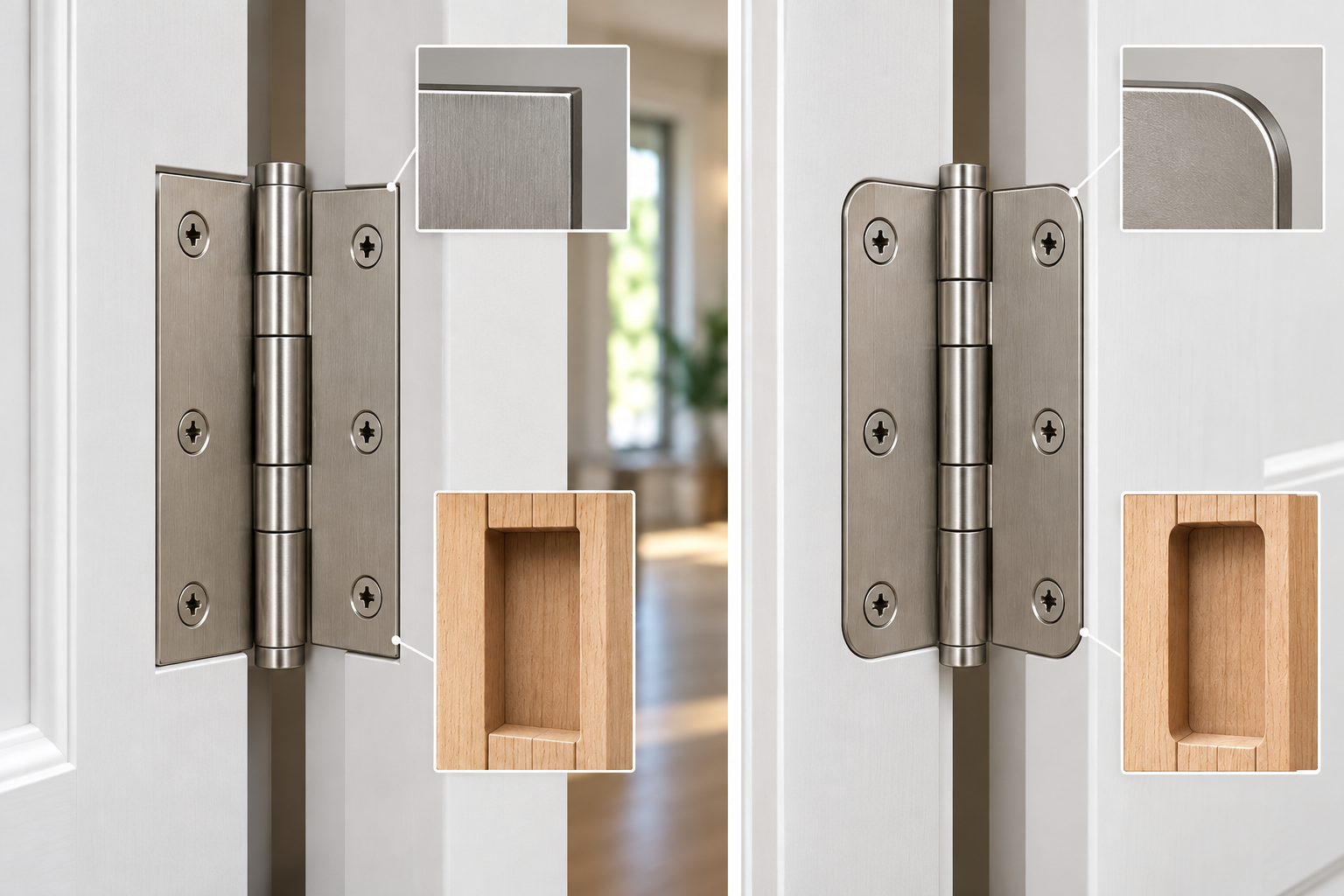
However, when it comes to installation efficiency—especially for large-scale developments, multi-family projects, or pre-hung door manufacturing—one tiny geometric detail changes everything: square corner vs. radius corner hinges.
Understanding the difference between these two hinge types can mean the difference between a seamless, high-speed installation and hours of expensive, labor-intensive handwork.
The Origin Story: Why Square Corners Were the Standard
Historically, all door hinges featured crisp, 90° square corners.
In traditional woodworking, carpenters mortised (recessed) hinges into door edges and jambs using a hand chisel and mallet. Because a chisel blade is flat and straight, creating sharp 90° right angles was the natural, standard way to prepare a pocket for the hardware.
While hand-chiseling works well for a single custom door or a historic restoration, it relies heavily on manual skill, takes significant time, and leaves room for human error.
The Technological Shift: Enter the Router and CNC Machinery
As construction modernized and the demand for pre-hung doors and volume manufacturing grew, manual labor gave way to power tools and automated machinery.
Today, door jambs and door slabs are mortised using electric routers or automated CNC machinery. Because router bits are round and spin on a central axis, a machine naturally cuts a pocket with rounded corners.
To make a square-corner hinge fit into a machine-routed pocket, an installer has to go back in manually with a chisel to square off the rounded corners.
Why Radius Corner Hinges Win for High-Volume Projects
If you are an architect writing specifications, a developer managing a multi-unit build, or a contractor preparing pre-hung door kits, radius corner hinges offer major operational advantages:
- Drastic Labor Reduction: Eliminating the need to hand-chisel every single jamb pocket saves minutes per door. Multiplied across dozens or hundreds of doors, this saves tens of hours in labor costs.
- Consistent Precision: Machine-routed pockets paired with matching radius hinges eliminate human error, ensuring a snug, clean fit every time.
- Optimized for Pre-Hung Door Manufacturing: Modern pre-hung door assembly lines rely entirely on automated routing. Specifying radius hinges keeps the production line moving without manual bottlenecks.
- Equal Unit Cost: From a hardware manufacturing standpoint, radius hinges cost virtually the same as square hinges. You get significantly faster installation without paying a premium for the hardware itself.
Sizing Matters: 1/4" vs. 5/8" Radius
When specifying or purchasing radius corner hinges, keep in mind that "rounded" comes in two standard industry measurements in the U.S.:
- 1/4" Radius: A subtle curve (roughly the size of a U.S. dime).
- 5/8" Radius: A wider curve (roughly the size of a U.S. quarter).
Pro Tip for Specifiers: Always match the hinge radius precisely to the router bit size used by your door manufacturer or pre-hanging supplier. A mismatch will leave unsightly gaps or prevent the hinge from sitting flush.
The Challenge: Availability and Procurement
Despite the obvious efficiency of radius corner hinges, many off-the-shelf retail suppliers still stock square hinges as their default.
To avoid project delays or accidental manual labor on-site, hardware specifiers and procurement managers must explicitly designate radius dimensions (1/4" or 5/8") during the early design and bidding phases.
Final Thoughts for Designers and Builders
Architecture and construction excellence often live in the unwritten details. While a square hinge and a radius hinge perform identically once installed, the path to getting them hung is radically different.
For small historical renovations, square hinges still have their place. But for modern, volume-driven construction where precision, schedule adherence, and labor budget matter, specifying radius corner hinges is one of the easiest efficiency wins available.
Key Takeaways for Your Next Specification
- For Architects & Engineers: Write radius requirements directly into your Hardware Schedules (Division 08) to prevent costly field modifications.
- For Contractors & Builders: Verify that your door supplier's mortise profiles match your hardware shipment before installation day.